Empty Rooms or Smart Strategy? How Villa Owners in Balangan Can Survive the Iran War Shock
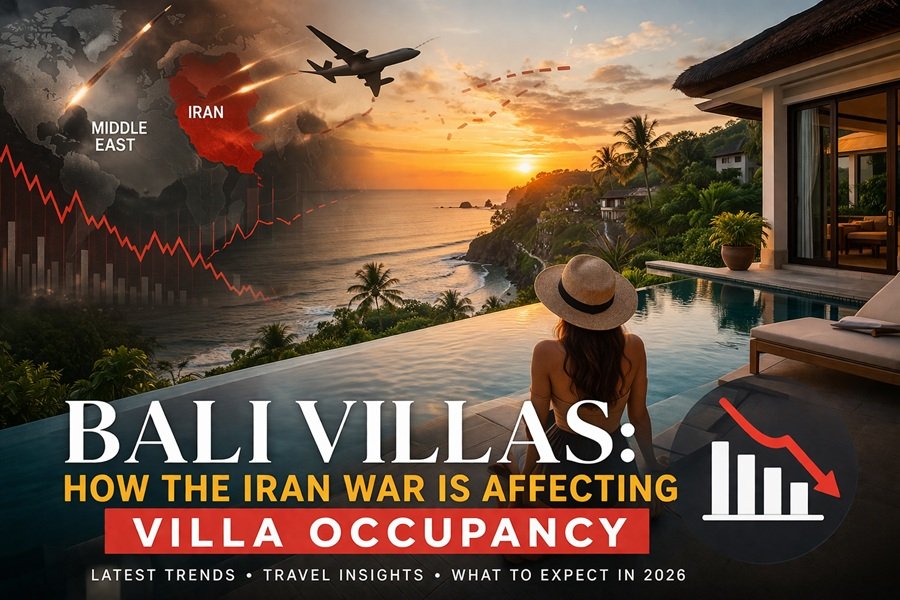
The dream of owning a villa in Bali has always been tied to one assumption: tourists will keep coming. In 2026, that assumption is being tested. The ongoing Iran war is no longer just a distant headline—it is quietly reshaping tourism flows, flight routes, and booking behavior across the island.
For Villa Maha Balangan and other properties in the area, the real question is no longer “Will guests come?” but “How do we adapt when they come differently?”
The Reality: Fewer Flights, Slower Bookings
The Iran war has disrupted global aviation in a way few expected. Major airspaces across the Middle East have been partially closed, forcing airlines to cancel or reroute flights.
In Bali, this impact is already visible. Within just one week of escalation, more than 60 international flights were canceled at Ngurah Rai Airport, directly affecting tourist arrivals.
At the same time, Bali has seen a decline of around 800 international visitors per day linked to the conflict.
For villa owners in Balangan, this translates into a clear pattern: fewer early bookings, more uncertainty, and guests who hesitate longer before confirming.
The Bigger Picture: Tourism Is Not Collapsing—It’s Shifting
Globally, the tourism industry is taking a hit. The Middle East alone is losing an estimated €515 million per day in tourism revenue due to the conflict.
But Bali is not collapsing—it is adjusting.
Travelers are still coming, but differently. They are avoiding complicated routes, choosing longer stays, and searching harder for value. Some are rerouting via Singapore or Bangkok instead of traditional Middle Eastern hubs.
For Villa Maha Balangan, this shift is not a threat—it is an opportunity, if handled correctly.
Strategy #1: Win the Long-Stay Guest
Short stays are becoming unpredictable. Long stays are becoming the new gold.
Guests who make the effort to reach Bali are more likely to stay for one week, two weeks, or even a month. Balangan, with its quiet beaches and slower pace, is perfectly positioned for this trend.
Villa owners who adapt pricing for weekly and monthly stays will see stronger occupancy stability compared to those relying only on nightly bookings.
Strategy #2: Sell Privacy, Not Just Accommodation
In uncertain times, travelers prioritize control and comfort.
Crowded hotels are losing appeal, while private villas gain attention. Balangan’s natural advantage—space, cliffs, and ocean views—should be positioned as a premium experience, not just a cheaper alternative.
Villa Maha Balangan should not compete on price alone. It should sell the feeling of escape, safety, and exclusivity.
Strategy #3: Be Flexible or Be Invisible
Rigid booking policies are a liability in 2026.
Travelers are dealing with flight uncertainty, rerouting risks, and changing plans. Villas that offer flexible cancellation, rescheduling options, and fast communication will convert significantly more bookings.
In this environment, trust becomes more valuable than price.
Strategy #4: Diversify Your Market
One of the biggest lessons from the Iran war is clear: relying on one market is dangerous.
Bali is now actively pushing diversification to stabilize tourism.
For Balangan villas, this means shifting focus beyond Europe and the Middle East. Australia, Southeast Asia, and domestic Indonesian travelers are becoming key markets because they rely less on disrupted air routes.
Villa Maha Balangan can survive—and even grow—by targeting these segments more aggressively.
Strategy #5: Master Last-Minute Booking Behavior
The booking window has changed.
Guests are no longer planning months in advance. Many are booking just days—or even hours—before arrival due to uncertainty in flights and global conditions.
This requires villa owners to stay active on platforms, adjust pricing dynamically, and maintain real-time availability.
In 2026, speed is a competitive advantage.
The Hidden Opportunity in Crisis
While many villa owners focus on declining numbers, smart operators see something else: less competition.
With fewer tourists, the market becomes more selective. Guests who arrive are serious, higher-intent travelers. They are not just browsing—they are ready to book.
This creates an opportunity for well-positioned villas like Villa Maha Balangan to capture a larger share of a smaller but more committed market.
The Future of Balangan Villas
The Iran war has proven one thing: Bali’s tourism industry is not fragile, but it is sensitive.
Occupancy may fluctuate. Bookings may slow. But the demand for Bali as a destination remains strong.
Villa owners who wait for “normal” to return may struggle. Those who adapt to the new behavior of travelers will survive—and potentially outperform.
For Villa Maha Balangan, success in 2026 is not about fighting the crisis. It is about understanding it, adjusting quickly, and turning global disruption into local advantage.
Because in Bali, even when the world changes, the right strategy can keep the rooms full.